Thanks to Ferrari man for posting this link in the general forum.
I thought I'd isolate both Kimi and Alonso for us to discuss in 2014
and I've isolated Vettel for us to look into 2015!
F1METRICS wrote:2014 model-based driver rankings
2014 was a year completely dominated by the Mercedes team, with the barest sniff of the title for Ricciardo. But who would have won the title if all cars had been equal? Were the Mercedes drivers the year’s best performers, or would other drivers have looked even better behind the wheel of a Mercedes? That’s a question you could debate for hours. Alternatively, we can pose the question to a mathematical model, such as the one I previously used to estimate all-time driver rankings.
In a nutshell, my model ignores races for each driver where they had non-driver failures (e.g., mechanical DNFs), then uses points per race in each of the remaining races as a performance metric for each season. While this is not a perfect metric (e.g., it doesn’t assign blame for crashes), it does capture one of the most important aspects of driver performance, and it can be easily applied across the board to all historical races without any subjective interpretation. Note that the model uses a scoring system based on the 10-6-4-3-2-1 system and includes fractional points for all lower race positions, allowing it to differentiate between drivers who finish 13th and 19th, for example.
Performance is assumed to be a function of both the driver’s performance and their team’s performance. Using the race results from 1950-2014, the model estimates the performance of each driver and each team so as to statistically best fit the race result data. This is possible because drivers are connected to one another by many different teammates, allowing their relative performances to be estimated.
2014 driver rankings
Using my model, I ranked the driver performances of 2014. Rankings are quantified by the adjusted points per race (ppr) up to a maximum of 10 ppr, as described previously. Each driver is discussed below. Note that the 2014 Marussia team and their drivers Jules Bianchi and Max Chilton were unranked, because to date Chilton and Bianchi have only driven alongside each other, so they cannot be compared to others. All other drivers are connected via common teammates. For the sake of completeness, I note that if we make the crude assumption that Marussia and Caterham were equal in performance in 2014, then the model ranks Chilton 17th and Bianchi 9th.
8. Kimi Raikkonen, 6.92 ppr
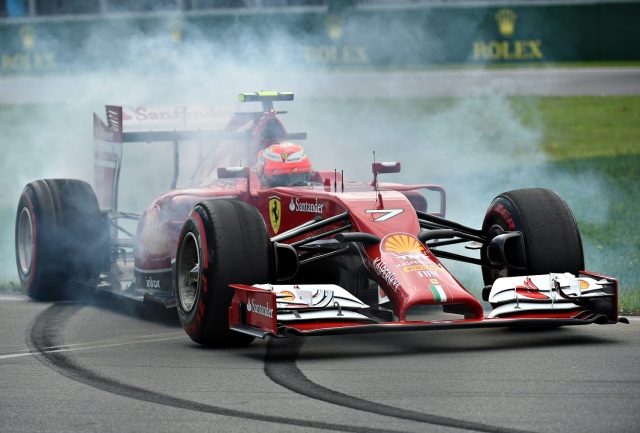
Last year, Raikkonen was widely considered a member of the sport’s elite four, alongside Alonso, Hamilton, and Vettel. It was an appealing narrative that helped fans mentally sort the grid into nice clean boxes. A humbling year for both Raikkonen and Vettel, as well as a close teammate battle at Mercedes, has undermined that simple hierarchy and shown that things are closer and more confusing than ever at the top.
Many fans and pundits were excited to finally see Alonso and Raikkonen in the same car. This was a prospect that had mouths watering as far back as 2003, when Alonso and Raikkonen graced the cover of the September 2003 issue of F1 Racing magazine.

Sadly, it proved to be a very one-sided fight.
Before the season began, my mathematical model predicted a 94% chance of Alonso coming out ahead across the season. The model predicted Raikkonen would score around two-thirds of Alonso’s points. In reality, the end-of-year points tally was 161-55 in Alonso’s favor, suggesting Raikkonen underperformed and/or Alonso overperformed.
Some would say this result was no surprise, given Massa had a slight edge on Raikkonen across 2007-2009 (beating him 25-19 in qualifying, 18-16 in races, and 213-195 in points) and Alonso made mincemeat of Massa. Others would say that Massa was performing at a higher level before 2010. Both arguments have some merit. Interestingly, the model thinks most drivers would have looked just as bad alongside Alonso in 2014.
So which factors have hampered Raikkonen? He had bad luck at Malaysia (hit by Magnussen), Spain (team favoritism), Monaco (collision with Chilton), and Germany (hit by Hamilton), but these races explain very little of the performance gulf to Alonso. Raikkonen also faced the challenge of moving to “Alonso’s team”. However, Ricciardo clearly had no difficulties moving to “Vettel’s team” and Senna had no difficulties moving to “Prost’s team” in 1988, so this also seems an inadequate explanation, especially given the crumbling relationship between Alonso and Ferrari.
An obvious culprit is the F14T. While the car’s terrible handling characteristics are clearly to nobody’s tastes, they play to Alonso’s ability to radically adapt his driving style as needed. Alonso is not infallible in this regard, as his troubles adapting to a new braking system and tyres in 2007 showed, but he seems to have a wider operating window than his teammate, who has previously shown great reliance on a responsive front-end. Raikkonen struggled badly with a new front suspension system at Ferrari in 2008 and had McLaren build him a different front suspension system from Montoya’s in 2005.
According to Raikkonen, he has also struggled to adapt to the more conservative tyres produced by Pirelli after the spate of punctures last year. Pirelli used a new kevlar construction for Germany 2013 then changed the compounds (favoring harder tyres) from Hungary 2013, continuing that trend into 2014 to avoid any potential tyre problems with the new engines. Looking at Raikkonen’s race performances relative to his teammates across that time period lends credence to his claim.

Prior to Hungary 2013, Raikkonen beat Grosjean 21-3 in races (excluding non-driver failures). After the change, Grosjean beat Raikkonen 4-2 in races and Alonso beat Raikkonen 16-1.
Sadly, we won’t see a Raikkonen vs. Alonso rematch, but getting to see Raikkonen vs. Vettel in 2015 is more than adequate compensation. To date, Vettel has faced only one known benchmark across a season (Mark Webber), making it difficult to place him and Ricciardo relative to other current drivers. This new teammate comparison will help shed light on the true hierarchy. Based on overall career performances, the model predicts a small edge to Vettel. Based on 2014 performances, the model predicts a small edge to Raikkonen. It should be a fascinating battle to watch.



 After the agony of defeat, success will be sweet!


 in his new Ferrari shirt:




 - By bud
 - By darwin dali
![On [img]http://tv4sports.com/wp-content/uploads/2014/03/espn_uk.png[/img], Staff](http://tv4sports.com/wp-content/uploads/2014/03/espn_uk.png)